Page Not Found
Page not found. Your pixels are in another canvas.

A list of all the posts and pages found on the site. For you robots out there is an XML version available for digesting as well.
Page not found. Your pixels are in another canvas.
ShuqiangChen
This is a page not in th emain menu
Published:
This post will show up by default. To disable scheduling of future posts, edit config.yml and set future: false.
Published:
This is a sample blog post. Lorem ipsum I can’t remember the rest of lorem ipsum and don’t have an internet connection right now. Testing testing testing this blog post. Blog posts are cool.
Published:
This is a sample blog post. Lorem ipsum I can’t remember the rest of lorem ipsum and don’t have an internet connection right now. Testing testing testing this blog post. Blog posts are cool.
Published:
This is a sample blog post. Lorem ipsum I can’t remember the rest of lorem ipsum and don’t have an internet connection right now. Testing testing testing this blog post. Blog posts are cool.
Published:
This is a sample blog post. Lorem ipsum I can’t remember the rest of lorem ipsum and don’t have an internet connection right now. Testing testing testing this blog post. Blog posts are cool.
Sleep spindles are transient oscillations during NREM sleep that are critical for memory consolidation. While spindle activity is known to be influenced by sleep stage, cortical up/down states, and infraslow activity, their relative contributions have remained unclear. In this work, we use a statistical framework to show that individualized temporal patterns are the primary drivers of spindle timing, revealing new insights into spindle production and offering an alternative lens for studying their role in memory, aging, and disease.
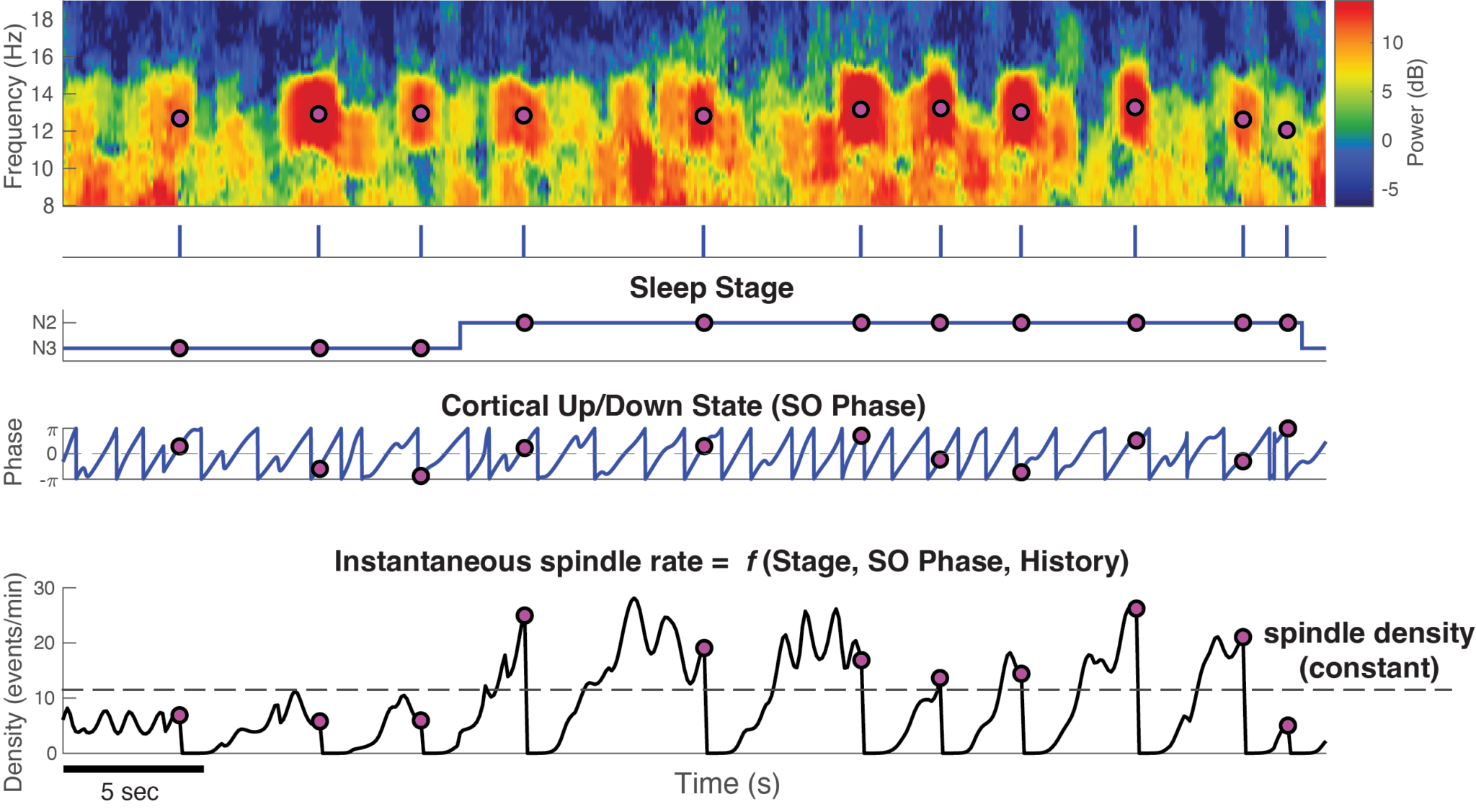
For more details, check the online toolbox here, which is in companion to the paper:
Shuqiang Chen, Mingjian He, Uri T. Eden, Michael J. Prerau. Individualized temporal patterns drive human sleep spindle timing. Proc Natl Acad Sci U S A (2025);122(2):e2405276121. doi: 10.1073/pnas.2405276121.
The AHI has been shown to be a poor descriptor of Obstructive Sleep Apnea (OSA). As a simple average respiratory event rate, it fails to capture the rich temporal structure and dynamic properties of these events, which vary continuously with factors such as body position, sleep stage, and prior respiratory activity. Here, we develop a statistical modeling framework based on point process theory that quantifies the relative influence of these factors on the moment-to-moment probability of event occurrence. This approach generates a highly individualized respiratory “fingerprint” capable of accurately predicting the precise timing of future events and reveals robust differences by age, sex, and race in a large population. Together, these advances offer a more detailed and dynamic characterization of OSA at both individual and population levels, with significant potential to improve patient phenotyping and outcome prediction.
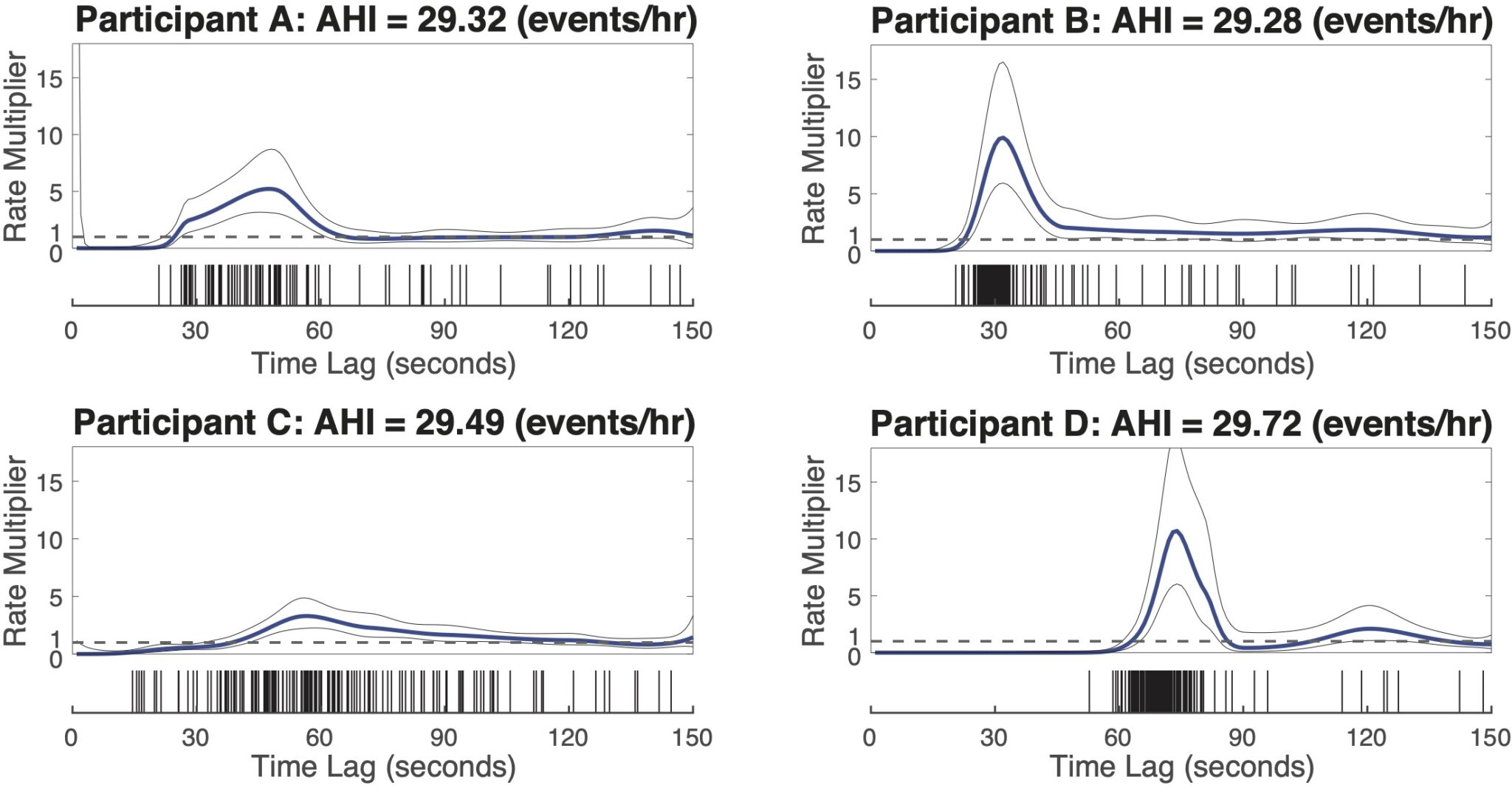
For more details, check the online toolbox here, which is in companion to the paper:
Shuqiang Chen, Susan Redline, Uri T. Eden and Michael J. Prerau. Dynamic Models of Obstructive Sleep Apnea Provide Robust Prediction of Respiratory Event Timing and a Statistical Framework for Phenotype Exploration. Sleep. 2022 Aug 6:zsac189. doi: 10.1093/sleep/zsac189.
Obstructive sleep apnea (OSA), marked by reduced or paused breathing during sleep, affects over 10% of the population and is tied to numerous comorbidities. Diagnosis and treatment decisions rely on the apnea–hypopnea index (AHI), yet it is treated as an exact point estimate without accounting for statistical uncertainty. In this work, we quantify that uncertainty using non-parametric bootstrap and theoretical Poisson approaches applied to data from over 2,000 participants in the MESA cohort, revealing that variability is substantial relative to clinical thresholds. Incorporating uncertainty and additional patient data is essential for more accurate diagnosis and treatment decisions.
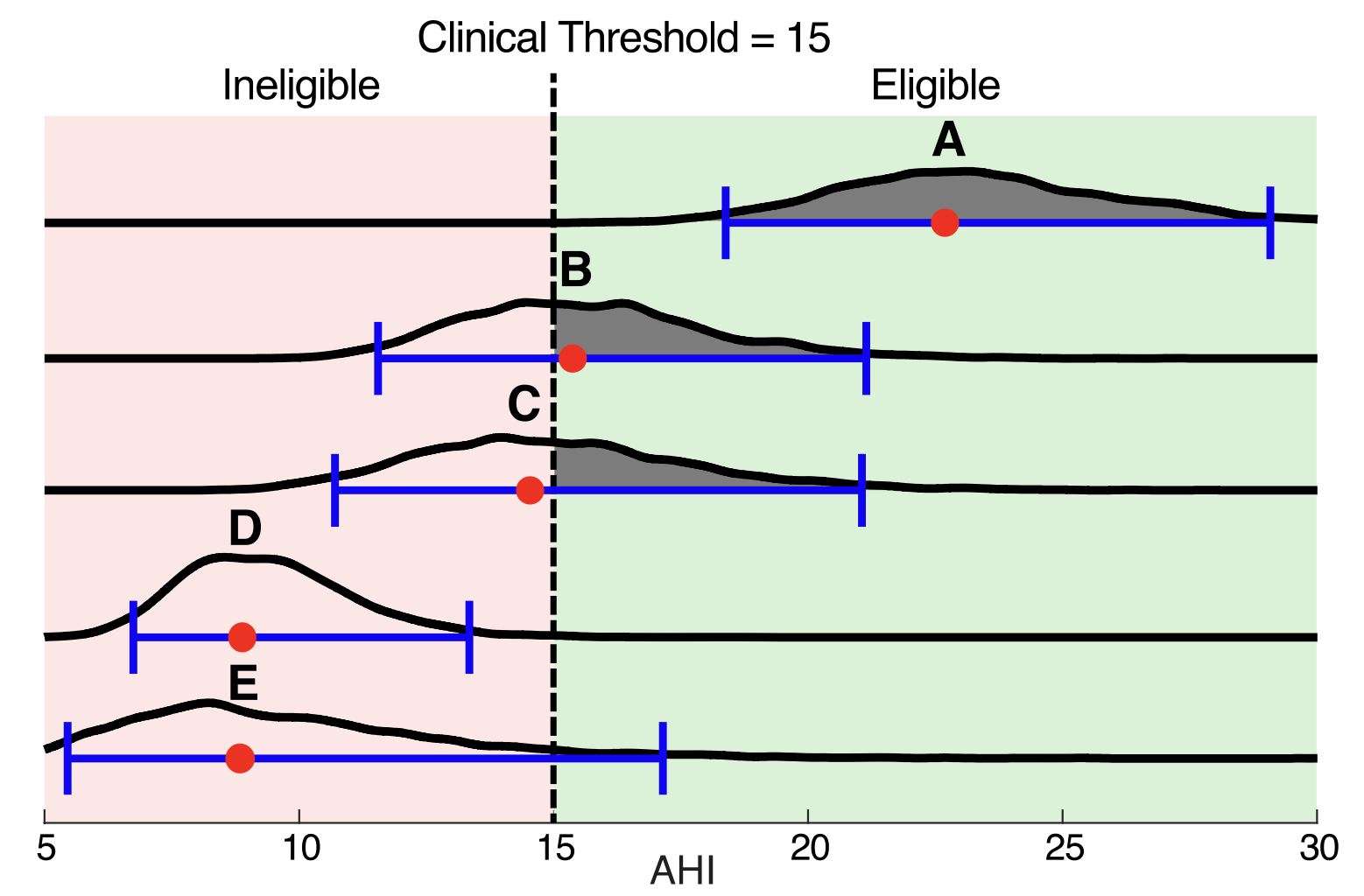
For more details, check the online toolbox here, which is in companion to the paper:
Thomas RJ, Chen S, Eden UT, Prerau MJ. Quantifying statistical uncertainty in metrics of sleep disordered breathing. Sleep Medicine. 2020 Jan;65:161-169. doi: 10.1016/j.sleep.2019.06.003.
Published:
This is a description of your talk, which is a markdown files that can be all markdown-ified like any other post. Yay markdown!
Published:
This is a description of your conference proceedings talk, note the different field in type. You can put anything in this field.
Undergraduate course, University 1, Department, 2014
This is a description of a teaching experience. You can use markdown like any other post.
Workshop, University 1, Department, 2015
This is a description of a teaching experience. You can use markdown like any other post.